
On paper, BRRRR looks like the safest strategy in real estate.
Buy below market. Rehab. Rent. Refinance. Repeat.
But in practice, most BRRRR deals don’t fail at rehab. They fail much earlier at the analysis stage, when investors quietly assume the refinance will “just work.”
That assumption is what traps capital.
The problem isn’t that investors don’t know how to underwrite. It’s that underwriting is still being done manually, emotionally, and inconsistently especially once deal volume increases. This is where AI for real estate investing stops being about speed and starts being about discipline.
Smart BRRRR investors don’t rely on optimism. They rely on systems.
[ASSET: Image | Search Term: "real estate investor underwriting dashboard BRRRR deal analysis" | Alt Text: "A modern underwriting dashboard showing BRRRR deal assumptions, conservative ARV, and refinance risk score."]

A modern underwriting dashboard showing BRRRR deal assumptions, conservative ARV, and refinance risk score.
Where BRRRR deals actually break
BRRRR failures are rarely dramatic. They don’t show up as obvious mistakes. They show up as small miscalculations that compound.
An ARV that’s slightly aggressive. Rent assumptions that reflect best-case tenants, not market ceilings. An appraisal that comes in lower than expected because lenders and appraisers tend to be more conservative than investors assume. A refinance timeline that stretches longer than planned due to seasoning or rate movement.
None of these issues kill a deal on their own. But together, they turn a “recycle your capital” strategy into a long-term cash lock.

A funny GIF symbolizing capital getting stuck when a BRRRR refinance doesn't go as planned.
Why manual underwriting breaks at scale
Spreadsheets work until they don’t.
When investors analyze a handful of deals per year, manual underwriting feels manageable. But as deal flow increases, confirmation bias creeps in. Investors start justifying numbers instead of stress-testing them. Bad deals don’t look bad they look “close enough.”
What breaks isn’t intelligence. It’s consistency.
That’s why ROI tracking after the fact isn’t enough. You don’t just want to measure performance you want to prevent bad deployments of capital in the first place. This is where systems like the AI ROI Tracker become useful early, not late, in the decision process.

An ROI tracker dashboard showing sensitivity ranges for ARV, rent, and refinance outcomes
The role of AI in BRRRR deal screening
AI doesn’t replace underwriting judgment. It removes emotional bias from it.
Instead of asking, “Can this deal work?” AI asks a better question:
“How often do deals like this actually work in this market?”
Modern AI market analysis looks for patterns across deals, not just isolated comps. It flags when assumptions fall outside historical norms. It highlights where refinance risk concentrates before money changes hands.
And because refinance timing and cost can be influenced by interest rate conditions, it’s smart to keep an eye on broader rate context (Federal Reserve).
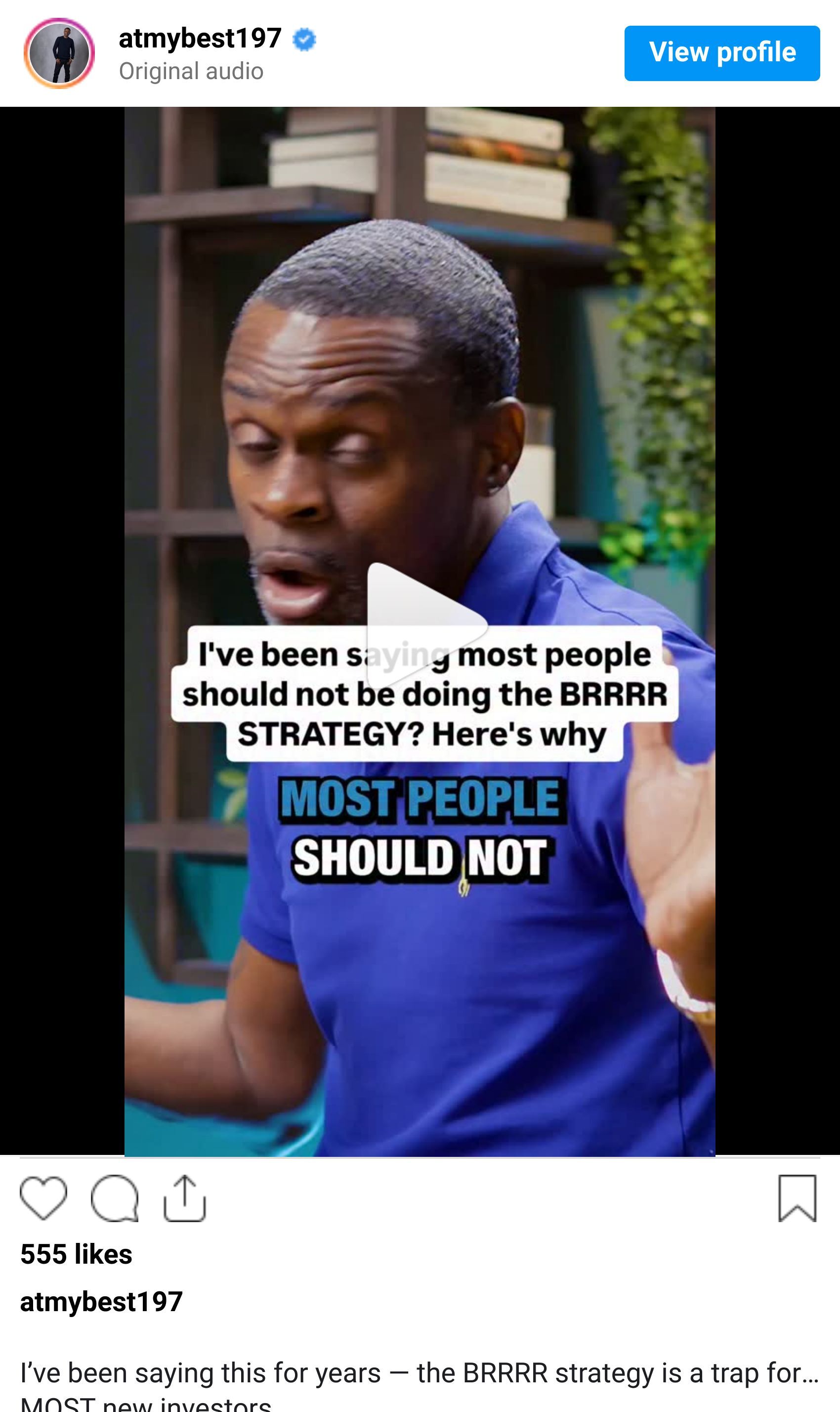
The Smart BRRRR AI workflow
Smart BRRRR investing isn’t about moving faster. It’s about filtering harder.
Here’s what an AI-driven BRRRR workflow looks like in practice.
Step 1: The lead enters the system
Every deal whether it comes from direct mail, inbound calls, or referrals enters a single pipeline. Before excitement builds, the deal is normalized and enriched.
This is where Lead Generation Management matters. You can’t analyze what you can’t standardize.

Pipeline view with stages from new lead to closed, including owner, last-touch, and next-step fields.
Step 2: Market and rent validation
Instead of trusting projected rents, AI evaluates real market ceilings. It looks at comparable rental performance, demand saturation, and price resistance.
If your rent assumptions only work in perfect conditions, the system flags it before you fall in love with the deal.
Step 3: Rehab and ARV sanity checks
Rather than cherry-picking comps, AI evaluates ARV ranges based on outcomes, not optimism. This matters because appraisers rarely reward best-case projections they reward defensible valuations.
Step 4: Refinance risk scoring
This is where most BRRRR deals quietly break.
AI stress-tests refinance scenarios by modeling:
LTV sensitivity
appraisal downside
seasoning delays
rate movement exposure
Instead of asking, “Can I refi?” the system asks, “What happens if this comes in 10–15% under expectations?”
Having this visibility inside a centralized decision environment like the AI Command Center keeps investors from emotionally committing to deals that don’t deserve capital.

A workflow diagram showing refinance risk scoring using LTV sensitivity and appraisal downside scenarios.
Why this protects capital not just ROI
The biggest benefit of AI market analysis isn’t higher returns. It’s fewer capital traps.
When deals are screened properly, fewer refinances stall. Lender conversations are cleaner. Capital recycling accelerates. Bad deals die early, quietly, and cheaply.
That’s the difference between investors who “do BRRRR” and investors who can sustain BRRRR over time.
[ASSET: Image | Search Term: "capital recycling flywheel real estate investing BRRRR" | Alt Text: "A flywheel diagram showing capital recycling from purchase to rehab to rent to refinance to repeat."]

A flywheel diagram showing capital recycling from purchase to rehab to rent to refinance to repeat.
How deal quality improves execution downstream
There’s a second-order effect most investors don’t anticipate: better deal screening improves everything else.
When you only pursue refinance-safe deals, seller conversations become more confident, follow-up becomes more focused, and pipelines stay clean.
That’s why AI-driven screening pairs naturally with systems like the AI Outbound Qualification Agent. You’re not just qualifying sellers you’re qualifying deals.

What to implement this week
You don’t need a perfect system to start. You need a minimum viable BRRRR intelligence stack:
Automated deal screening before emotional buy-in
ROI tracking tied to conservative assumptions
Decision thresholds for “walk away” scenarios
If a deal can’t survive conservative modeling, it shouldn’t survive your pipeline.
Final thought: Smart BRRRR isn’t about speed
The most successful BRRRR investors aren’t the fastest. They’re the most disciplined.
They say “no” more than they say “yes.” They trust systems more than spreadsheets. They protect capital before chasing yield.
AI doesn’t make BRRRR risk-free but it does make risk visible. And visibility is what keeps capital moving instead of getting stuck.

A satisfying GIF of a checklist being completed to reinforce implementing the Smart BRRRR workflow.
